Preserving the Gullah Geechee – Heirs Property
– Dandre Majorbartley June 2026
St. Helena Island S.C
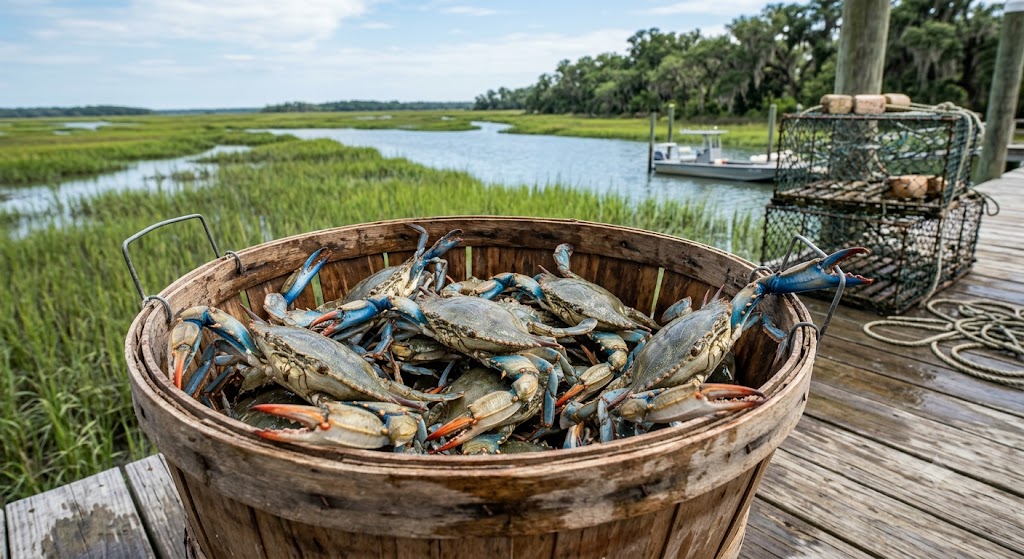
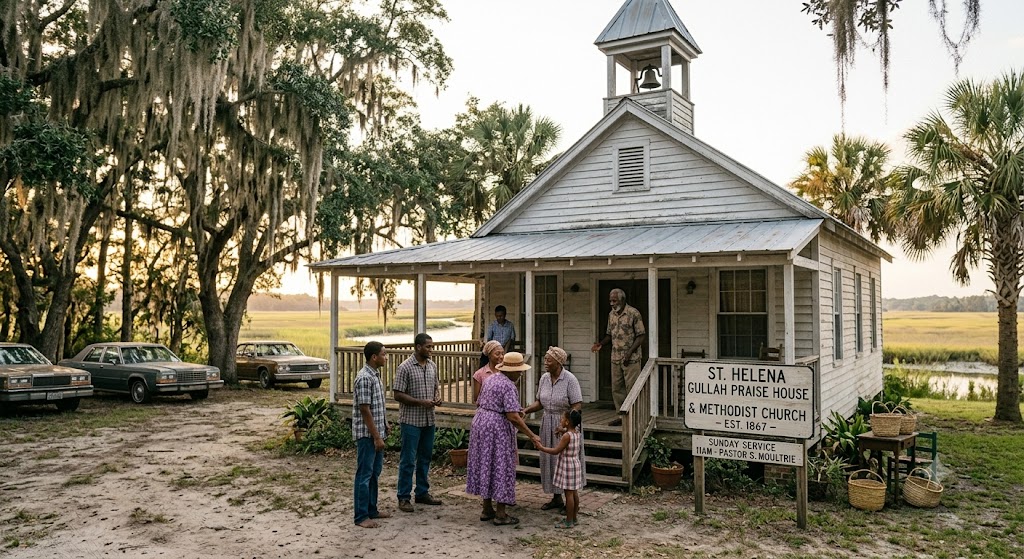
Across the South Carolina Lowcountry, particularly on Saint Helena Island, a quiet crisis threatens the survival of one of America’s most culturally distinct communities. Land that has been passed down through generations of Gullah Geechee families since the dawn of Reconstruction is being systematically lost to modern coastal development, luxury resorts, and skyrocketing property taxes.
At the center of this battle is the complex legal vulnerability known as heirs’ property. When land is passed down through generations without a formal legal will, it belongs collectively to all living descendants. Over decades, a single plot of land can accumulate dozens or even hundreds of lawful heirs. Because there is no single deed holder, the land lacks a clear, marketable title, leaving historic family plots deeply exposed to predatory real estate practices.
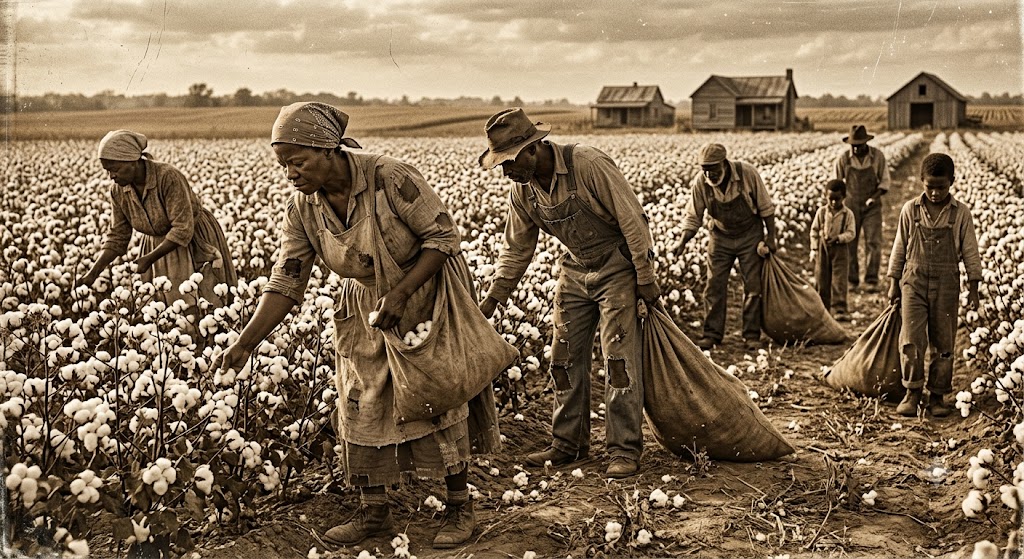
Under current property laws, a developer can purchase the interest of a single distant heir and legally force a partition sale, putting an entire family tract up for public auction. For the Gullah Geechee people, losing this land means losing their cultural anchor. According to data compiled by the Center for Heirs’ Property Preservation, there are an estimated 100,000 acres of heirs’ property scattered across the Lowcountry of South Carolina alone. As rapid urban development creeps outward from historic downtown Beaufort and luxury resorts multiply across neighboring sea islands, St. Helena stands as one of the final, ungated strongholds of intact Gullah Geechee heritage.
The battle for this land is more than a property dispute; it is a critical human rights effort to preserve a living component of American history before it is permanently paved over.
The Legal Architecture of Loss
To understand how a family can lose land they have occupied since the 1860s, one must navigate the predatory mechanics of Southern property law. When a landowner dies intestate without a legally binding will state law dictates that ownership fractionally divides among all legal heirs. Over four or five generations, a single ten-acre tract can accumulate hundreds of co-owners, many of whom have migrated to distant cities and hold no physical connection to the soil.
Under South Carolina partition laws, any single fractioned owner, no matter how small their percentage of ownership, has the legal right to petition the courts to divide or sell the entire property. Speculative developers exploit this dynamic by tracking down distant, estranged heirs, purchasing their minuscule share of the estate for a fraction of its value, and immediately filing a partition lawsuit. Because historic Lowcountry tracts are rarely easy to physically divide equally among hundreds of owners, courts routinely order a forced partition sale at public auction. The entire family estate is sold to the highest bidder, effectively evicting the resident family members who have tended the land for lifetimes.
“Heirs’ property is a ticking time bomb for families like ours,” explains Ronald Simmons, a St. Helena native who lives on and works his family’s generational land. “We’ve spent our lives working these fields and paying the property taxes, but because the title is clouded among so many relatives, the law doesn’t treat it as truly ours. You can’t go to a bank to get a mortgage to build a traditional home on your own soil. Even worse, when a major hurricane hits the Lowcountry, you face massive roadblocks trying to get FEMA or federal disaster assistance to rebuild because the government says your title isn’t ‘clear.’ Just working the land and loving it isn’t enough to keep it safe anymore.”
Compounding this legal vulnerability is the crushing weight of gentrification-induced property taxes. When a luxury subdivision or a private golf resort springs up adjacent to a historic Gullah Geechee settlement, regional land values skyrocket. Data from Beaufort County property records indicates that coastal property valuations in the county have surged by over 45% over the past decade, driven by an influx of affluent retirees and seasonal tourism development. For working-class families living on ancestral land, these inflated tax assessments create an unsustainable financial burden, frequently leading to tax default sales where generations of family history are sold on the county courthouse steps.
Cultural Significance
For the people who call St. Helena Island home, the land is not merely an asset to be bought, sold, or leveraged; it is a sacred repository of identity, lineage, and spiritual connection.
“Our ancestors bought this land with sweat, blood, and coins they saved while transitioning out of bondage,” says Susie Simmons, a direct heir to St. Helena Island property. “When you take a Gullah Geechee person off their land, you are committing cultural erasure. You cannot practice Gullah Geechee culture in a suburban apartment complex or behind the security gates of a luxury subdivision.”
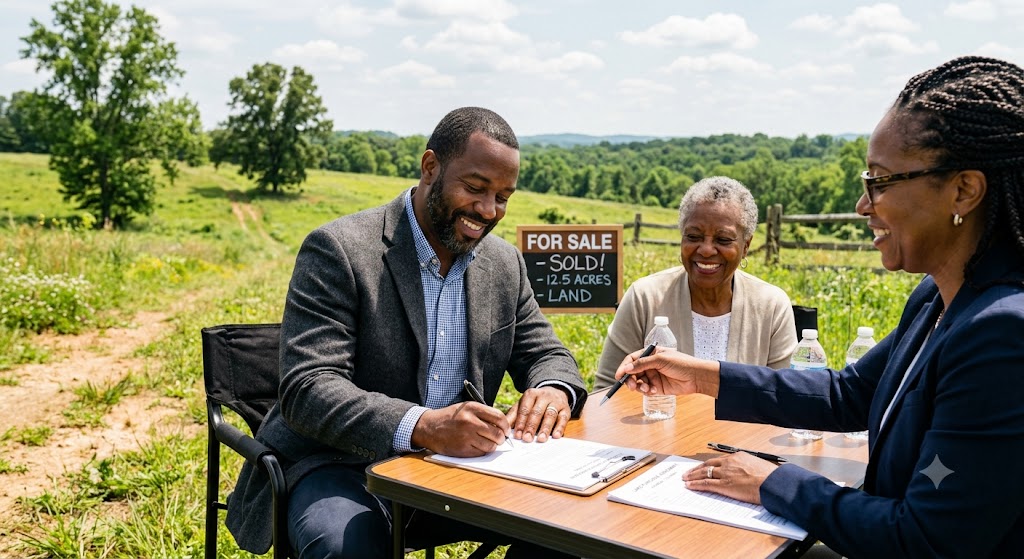
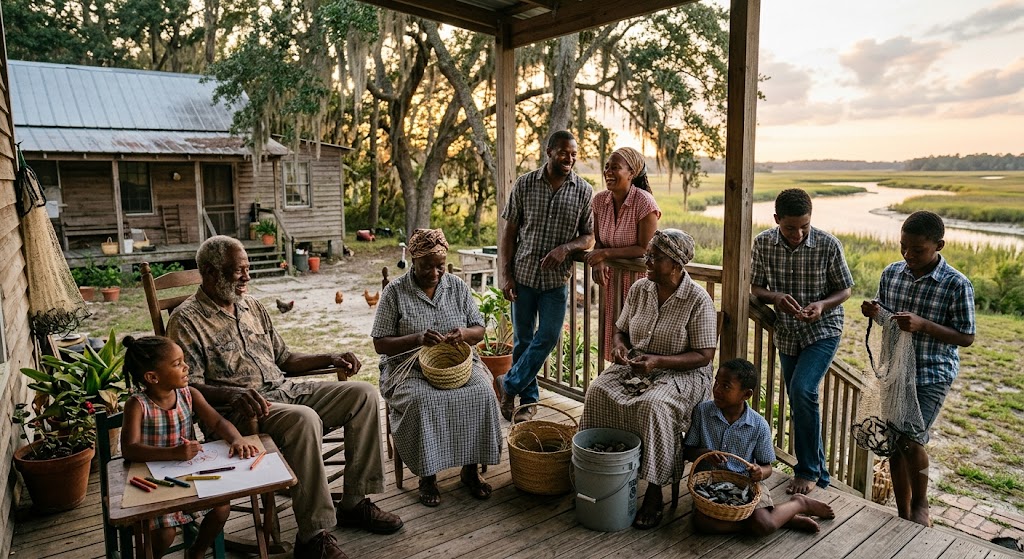
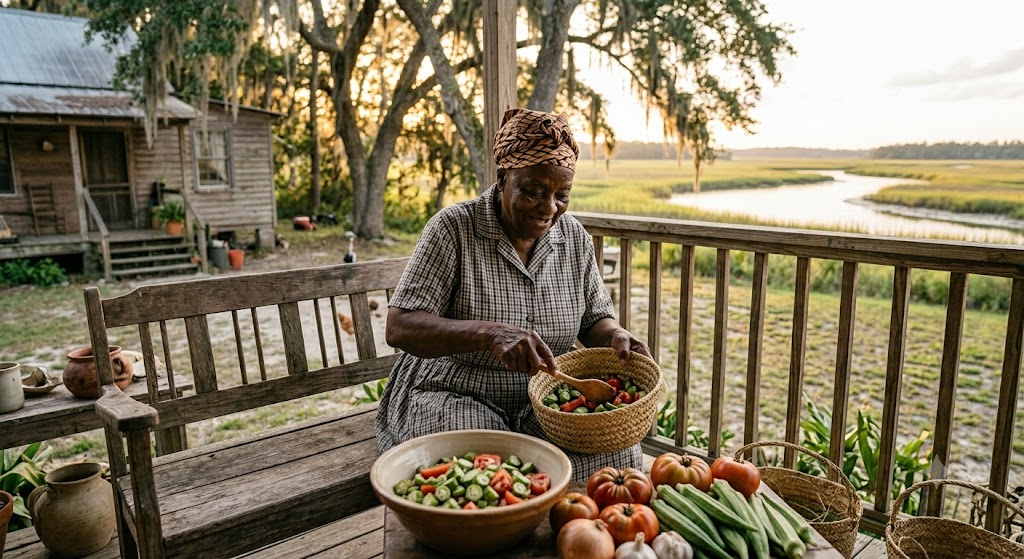
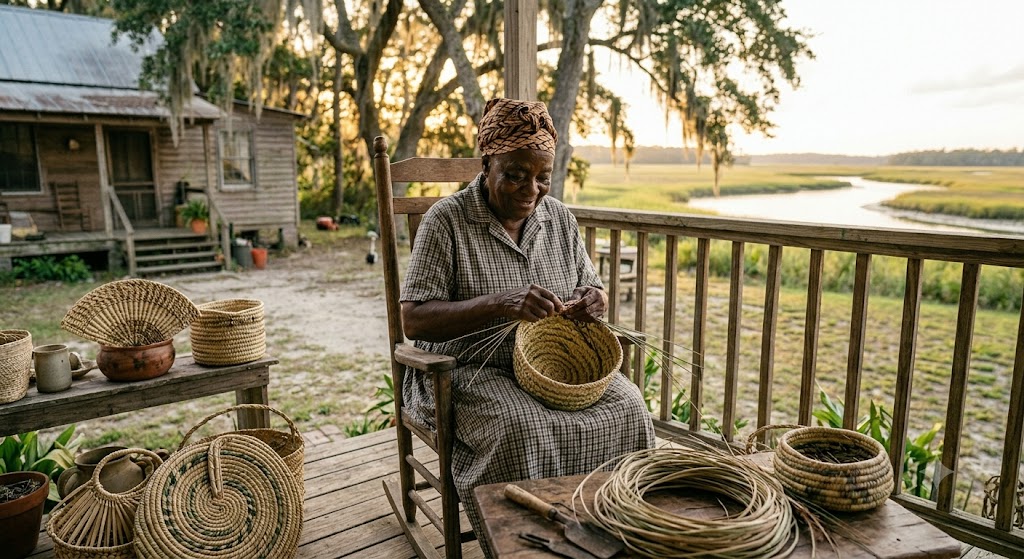
The Gullah Geechee people are direct descendants of enslaved Africans who were brought to the isolated sea islands of South Carolina, Georgia, and Florida to cultivate rice, indigo, and cotton. Because of their geographic isolation from the mainland, they preserved more of their African linguistic, cultural, and agricultural heritage than any other African American community in the United States. From the unique Gullah dialect and complex sweetgrass basket weaving techniques to traditional net fishing and communal farming practices, this culture is fundamentally tied to the physical land and waterways of the Lowcountry.
Without access to their ancestral land, traditional practices cannot survive. When a family is displaced by development, a centuries-old cultural line is severed. Protecting heirs’ property is not merely a legal battle over real estate; it is an urgent human rights effort to preserve a living, breathing component of American history.
Local elders emphasize that the land has historically provided complete economic self-sufficiency, a reality that modern commercial development directly threatens.
“Y’all have to understand, our family doesn’t just own a plot of land—we built a whole life here with a family compound and a local club,” notes Dantavis Fripp, a 38-year-old St. Helena resident and lifelong farmer. “Growing up here, the land and the river provided everything. We grew our own greens, raised our livestock, and went out into the river to catch fish and crabs. Now, you look around and see ‘No Trespassing’ signs on paths our families walked for a hundred years. Running a family business and maintaining a compound is a constant struggle when the deed is split among so many people. If our young people lose their connection to this soil, they won’t have anything left to anchor them to who they are.”
The generational trauma of land loss echoes through families who have already witnessed the transformation of neighboring islands.
“Look at what happened to Hilton Head Island,” says Myiesha Williams, a prominent local cultural preservationist and loctician. “It was once a self-sufficient Gullah paradise. Today, it’s a grid of gated plantations where the original people can’t even access the beaches without passing a security guard. We are fighting every single day to ensure St. Helena does not suffer that same fate. The land is our identity; without it, we are invisible.”
The Cultural Protection Overlay
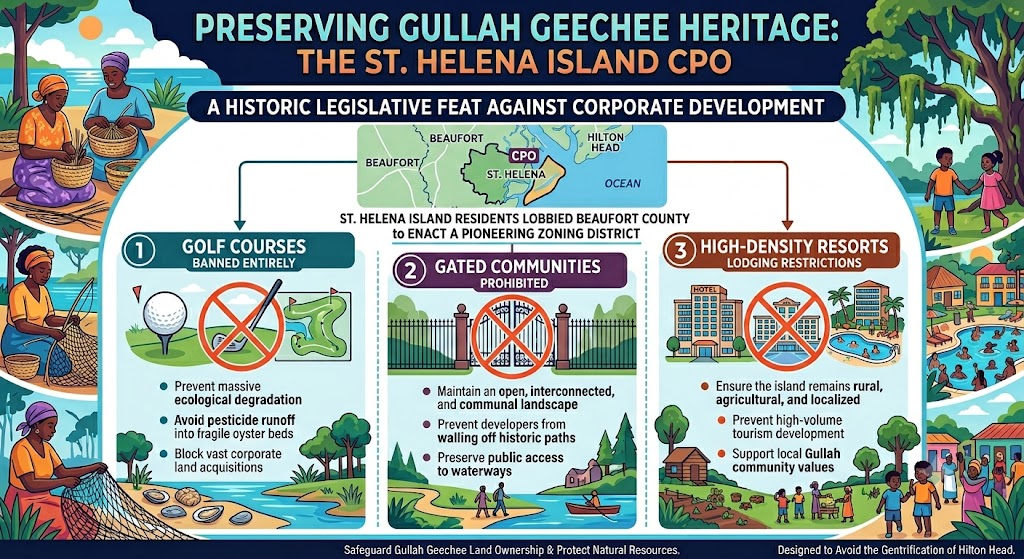
Faced with the relentless pressure of corporate development, the residents of St. Helena Island pulled off a historic legislative feat in 1999 by lobbying Beaufort County to enact the Cultural Protection Overlay (CPO). The CPO is a pioneering zoning district designed explicitly to safeguard Gullah Geechee land ownership, protect natural resources, and block the specific types of development that fueled the gentrification of Hilton Head.
The CPO strictly prohibits three distinct elements across St. Helena Island:
- Golf Courses: Banned entirely to prevent massive ecological degradation, pesticide runoff into fragile, active oyster beds, and vast corporate land acquisitions.
- Gated Communities: Prohibited to maintain an open, interconnected, and communal landscape, preventing developers from walling off historic paths and public access to waterways.
- High-Density Resorts: Lodging restrictions ensure the island remains rural, agricultural, and localized.
While the CPO has served as an incredibly effective legal shield for over two decades, it faces constant challenges from outside investors seeking text loopholes. The most prominent battle centered around Pine Island, a pristine 502-acre peninsula on St. Helena. A wealthy developer purchased the tract and sought an amendment to build a luxury gated community and a 19-hole championship golf course, sparking a multi-year legal showdown.
The community’s response was swift and uncompromising. Through packed county council meetings, public rallies, and legal interventions supported by the South Carolina Environmental Law Project (SCELP), residents successfully defended the overlay. In a decisive move, the Beaufort County Council ultimately voted to deny the developer’s variances and passed sweeping text amendments to close any potential loopholes, firmly codifying the strict protections of the CPO into the county’s unified development code.
“The CPO is our line in the sand,” states Leland Howel, a local fisherman whose livelihood depends on open access to the water. “It proves that community solidarity and cultural preservation can legally withstand the pressures of multi-million-dollar development. But zoning alone isn’t a permanent fix. If a family’s title is clouded under heirs’ property, the land remains vulnerable from within. We must pair municipal zoning protections with aggressive, individual legal title clearance.”
Designing a Path Forward
Defending the Lowcountry’s heritage requires moving beyond defensive legal battles toward proactive, sustainable solutions. By securing clear land titles, establishing sustainable family businesses, and teaching younger generations the value of their lineage, the Gullah Geechee community is creating an enduring shield against displacement. Ensuring that these families retain ownership of their ancestral soil guarantees that the vibrant history, language, and spirit of the Lowcountry continue to thrive for generations to come.
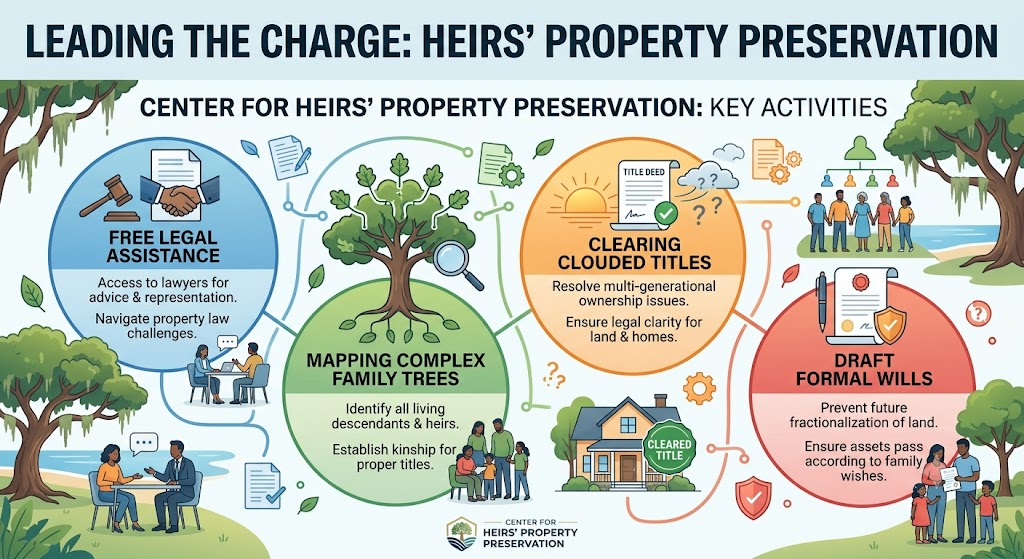
Organizations like the Center for Heirs’ Property Preservation are leading this charge by providing free legal assistance, helping families map complex family trees, clear clouded titles, and draft formal wills to prevent future fractionalization. Furthermore, advocates are training landowners to view their property as an active economic asset through sustainable forestry and local agricultural collectives, enabling families to generate enough revenue to easily cover rising property taxes.
On an international level, institutions like the Penn Center, located right on St. Helena Island and designated as a National Historic Landmark District, continue to serve as critical hubs for education, documentation, and global cultural exchange. By teaching younger generations the precise history of the land, local leaders are ensuring the preservation movement remains sustainable.
The battle for Gullah Geechee heirs’ property serves as a profound lesson for communities nationwide. It demonstrates that land preservation is not merely about protecting open green spaces or coastal ecosystems; it is about protecting the human communities intertwined with those landscapes. Securing clear titles, upholding strict cultural zoning laws, and fostering community-led economic models ensures that the vibrant language, rich traditions, and enduring spirit of the Lowcountry will remain firmly rooted in its ancestral soil for generations to come.

 As Easy As You MAke it.com
Leave a comment